
Sammamish Address History By Era
The right first source depends on the year. Sammamish has no verified local run of criss-cross or city directories in the official sources reviewed, so the record trail must state that gap. County deeds and archival series provide the firm ownership spine. Census and local-history materials can then test who occupied the place.
| Source | Time span | Where to use it | What it can show |
|---|---|---|---|
| Landmark recorded-document index | 1976 to present | King County Recorder online | Recorded parties, document type, date, parcel or legal terms |
| Landmark parcel search | 1997 to present | Recorder parcel mode | Documents tied to the current 10-digit parcel |
| Older recorded images | Before August 1991 when absent online | King County Archives | Deeds and related recorded instruments |
| Federal census schedules | Through 1950 under the 72-year release rule | NARA or library databases | Household members and census geography |
| Permits and city files | City era, with older files possibly at county | MyBuildingPermit or records request | Applicants, projects, inspections, and dated site activity |
Start with the most recent official parcel and deed, then move back. For a nineteenth or early twentieth-century question, begin with historic place names, census geography, archives, and local collections before trying to impose a modern Sammamish address on the record.
Reverse A Sammamish Deed Chain
A chain of title is the sequence of recorded transfers affecting a parcel. It identifies owners, not all previous residents. The King County assessor supplies a current parcel number and legal description. The Landmark recorder index then connects that parcel or description to recorded instruments.
- Resolve the current address in Parcel Viewer and save the parcel, jurisdiction, site address, and legal description.
- Open eReal Property and record the taxpayer role without calling that person an occupant.
- Search the current parcel in Landmark and locate the latest deed or other transfer instrument.
- Read the grantee, who received the interest, and grantor, who conveyed it. Search the seller as an earlier grantee.
- Repeat until the parcel search reaches its cutoff. Then switch to name, subdivision, lot and block, section, township, range, or Archives.
- Grantor and grantee
- The grantor conveys a recorded interest; the grantee receives it.
- Chain of title
- The linked sequence of recorded transfers for the property.
- Legal description
- Lot, block, subdivision, survey, or other land wording that can outlast a street address.
Record the instrument number, date, party roles, document type, and legal text at each step. An index hit is a lead. The document image supplies context, and a certified copy must come from the Recorder's Office.
Sammamish Deeds Beyond The Cutoffs
A current parcel number may fail to reach the oldest deed. Landmark indexes documents from 1976, while its parcel search begins in 1997. Online certified and copy ordering applies to documents after August 1991. These three dates describe different access limits and should not be blended into one cutoff.
Use legal, advanced legal, or name searching when the parcel link stops. The legal modes accept subdivision, lot, block, section, township, range, plat book, quarter, and text matching. For a missing pre-1991 image, use the King County Archives recorded-document service. Archives may also hold short plats, easements, property cards, and microfilm.
Check the official archive cutoff and access instructions beside this captured reference.
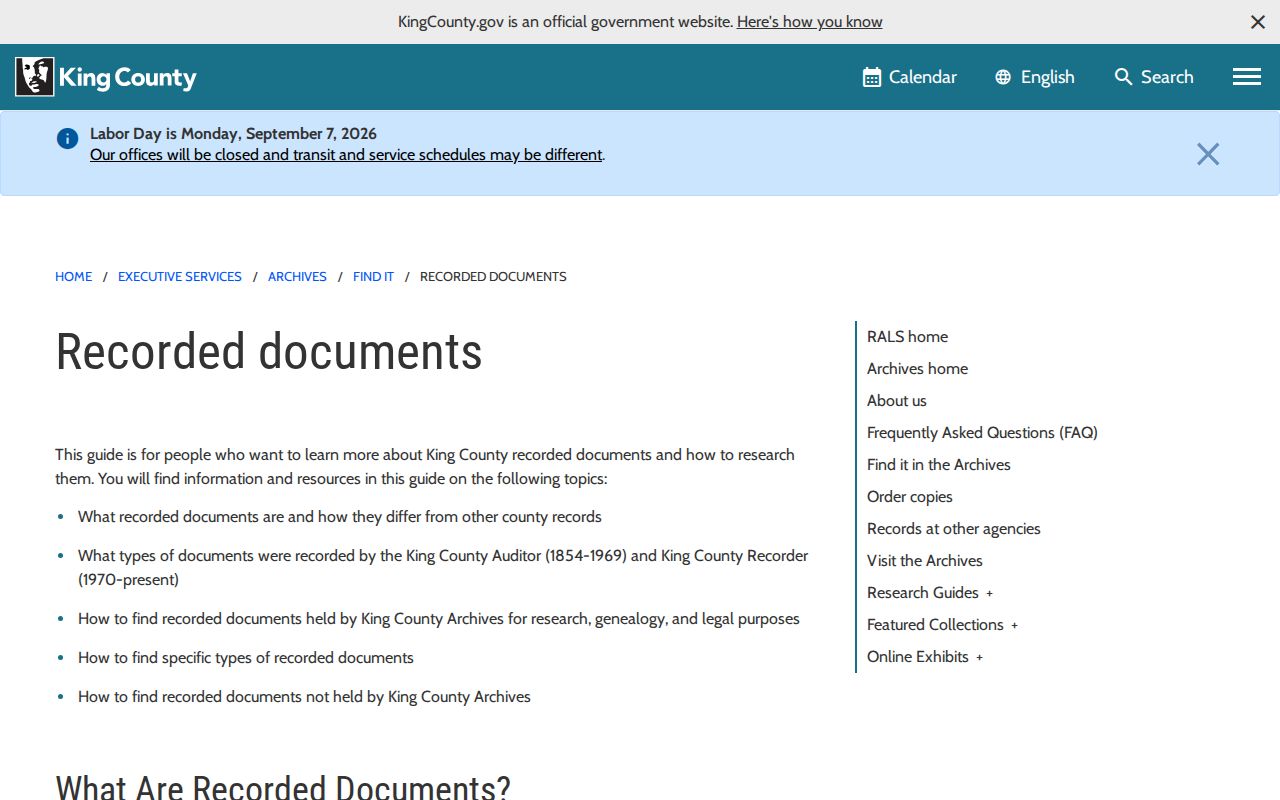
The archive route bridges an unavailable image without pretending the deed or the former occupant does not exist.
Former Names For Sammamish Residents
Sammamish incorporated on August 31, 1999. Earlier records may use King County, Issaquah, Redmond, school-district names, rural routes, or plateau communities. Inglewood, Monohon, Beaver Lake, Pine Lake, Lake Sammamish, and Beaver Lake Colony can be the only bridge to a census, newspaper item, photograph, or directory entry.
Search the current road and historic place in parallel. For a Beaver Lake property, test the colony, resort, school district, township and range, and county. For an Inglewood lead, test Monohon, Lake Sammamish, Redmond, and rural-route forms. Keep the original label in the citation even after modern geography is resolved.
Klahanie joined Sammamish effective January 1, 2016. A newer municipal label should not be assigned backward to an earlier record without noting the annexation date. This geography is not trivia. It determines which custodian and catalog may hold evidence of previous residents.
Pair Sammamish Households With Census
Owners form only one layer of a house history. A non-owner occupant or relative may never appear in the deed chain. Federal census schedules, released after 72 years, can show a household and its census geography through 1950. Old directories, when a relevant regional entry is actually found, can supply a dated address between census years.
The pairing should run as a controlled flow: historic place and address variant, census enumeration, directory or archive lead, deed or plat confirmation, then obituary, cemetery, probate, photograph, or oral history. Each record has a separate job. A census household does not prove ownership, and a deed does not prove every occupant.
- Choose a target year and copy the historic address or place label exactly.
- Locate the household in the closest released census and note names, ages, roles, and geography.
- Search the years between censuses in catalogs, regional directories, newspapers, and archive descriptions.
- Compare each name with the deed chain, probate record, or dated image while preserving conflicts.
The Sammamish city directory collections page explains the available shelf and its gaps. Seattle directories from 1867 through 1928 are regional leads, not proof that a listed person lived on the Sammamish plateau.
Sammamish Library Research Access
The Sammamish Library is a practical catalog and referral point with scanning, printing, fax, Wi-Fi, and staff help. It is not proof that a complete local directory run exists. No Sammamish-specific digitized city-directory run was located in the official page and catalog review.
KCLS access hours changed in 2025, including Sunday opening and a later construction schedule, so check the branch page before visiting. That time-sensitive detail matters when the next step depends on staff help or equipment. A library visit can open a catalog, scan an item, and identify a repository, but it does not unlock a restricted record.
Review the current Sammamish Library services and hours with the captured branch view.
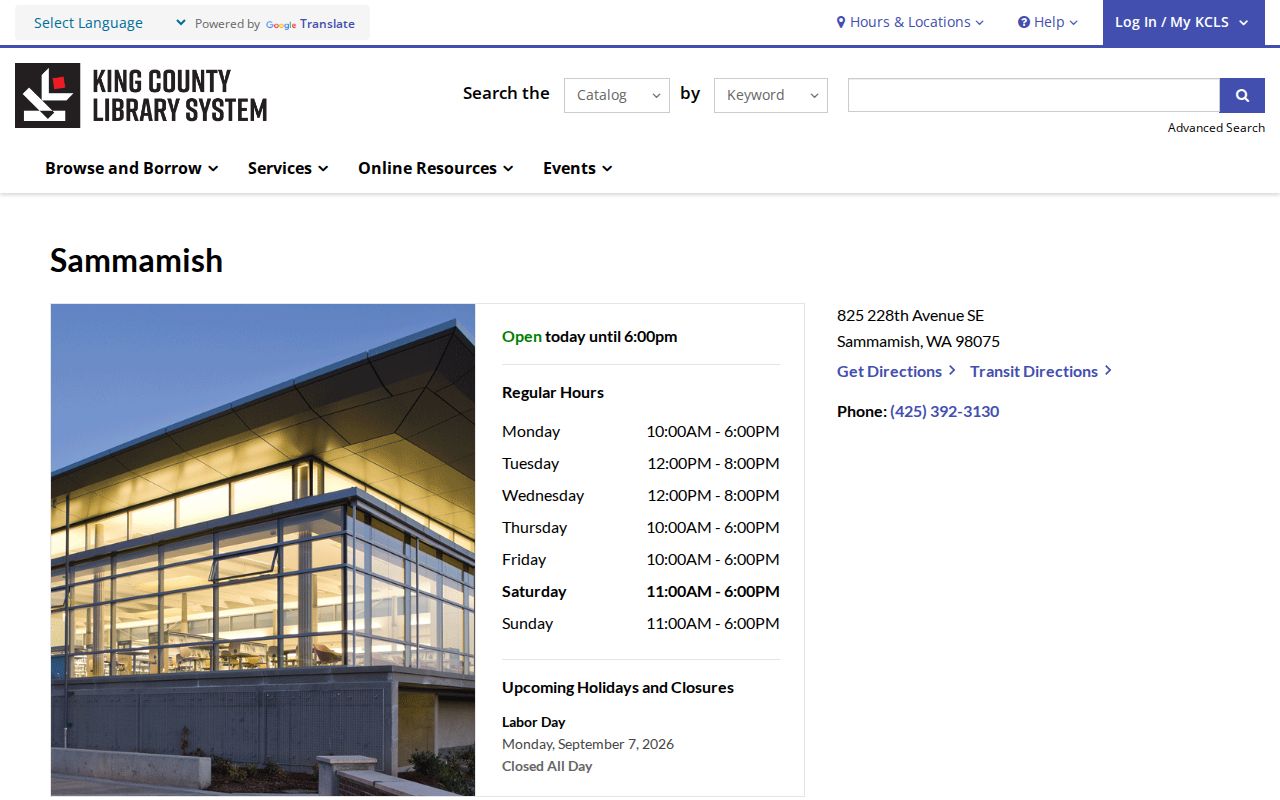
The branch serves as a local research desk even when the actual volume or county file is held elsewhere.
Sammamish History Beyond Directories
The King County Collects project brings together cross-institutional digital material and points toward Sammamish Heritage Society content. Photographs, captions, oral histories, maps, artifacts, and community accounts can identify a person or place at a date. Treat each as a lead with provenance, not automatic proof of residence.
For every item, note who supplied it, the depicted or recalled date, the named people, the place, repository, and whether the caption is contemporary or retrospective. Then corroborate the claim with a census, deed, plat, permit, or other dated primary source.
Search the countywide digital collection through the captured portal.

The cross-repository search broadens the trail without claiming a local directory that the research did not locate.
A Sammamish Map Research Gap
No Sammamish-specific Sanborn fire-insurance sheet was located in the official sources reviewed. That is a search-scope finding, not proof that no map or property image exists. Sanborn maps can date building footprints and uses where coverage exists, but substituting a sheet from a nearby city would give a false sense of precision.
Use recorded plats, assessor records, aerial layers, county archive series, city project maps, and permit files instead. A plat can explain a vanished road, renumbered lot, easement, or common tract. Legal descriptions are often the safest bridge after a street number or city line changes.
Note: Record a negative result as “not located in the reviewed catalog,” then name the lawful archive or library route for follow-up.
Sammamish Owners Versus Occupants
A former owner and a former occupant are not interchangeable. The assessor's taxpayer field is a tax-record clue. A grantee is a party receiving an interest. A permit applicant is attached to a project. A census name is tied to a household and date. An oral-history subject may be recalling a place rather than documenting an address.
| Record role | Sound conclusion |
|---|---|
| Taxpayer | Name used for the assessed property record on the date checked |
| Recorded party | Person or entity with a named role in a recorded instrument |
| Census household member | Person enumerated in that household and census geography |
| Permit applicant | Person or firm associated with a dated permit action |
| Photo or oral-history subject | Named lead that needs source context and corroboration |
Conflicts often come from mailing versus situs fields, postal city versus municipality, taxpayer versus occupant, or a later annexation. Explain the difference rather than choosing the newest label by default.
Complete A Sammamish Resident Trail
Obituaries, cemetery indexes, probate files, and vital records can close a family-history trail after a person left the address or died. Washington Digital Archives offers collection filters for cemetery, census, death, land, maps, marriage, military, oral history, photographs, real-property cards, and court cases, though not all collections are digitized or name-indexed.
If a city-era permit is needed, search MyBuildingPermit by Sammamish jurisdiction and location. Pre-1999 permit records may route to King County. The city accepts public-disclosure requests online, by email, mail, and in person. Ask for an existing record category, address or parcel, date range, and file format instead of asking the city to create an answer.
A complete result may end at a protected address, restricted vital record, missing pre-1991 image, or unindexed collection. State the gap and custodian. Do not replace it with a weak identity match.
Lawful use. Research Sammamish previous residents for house history, genealogy, heirs, or personal curiosity. Stop at protected addresses, and never track, expose, stalk, or harass a living person.